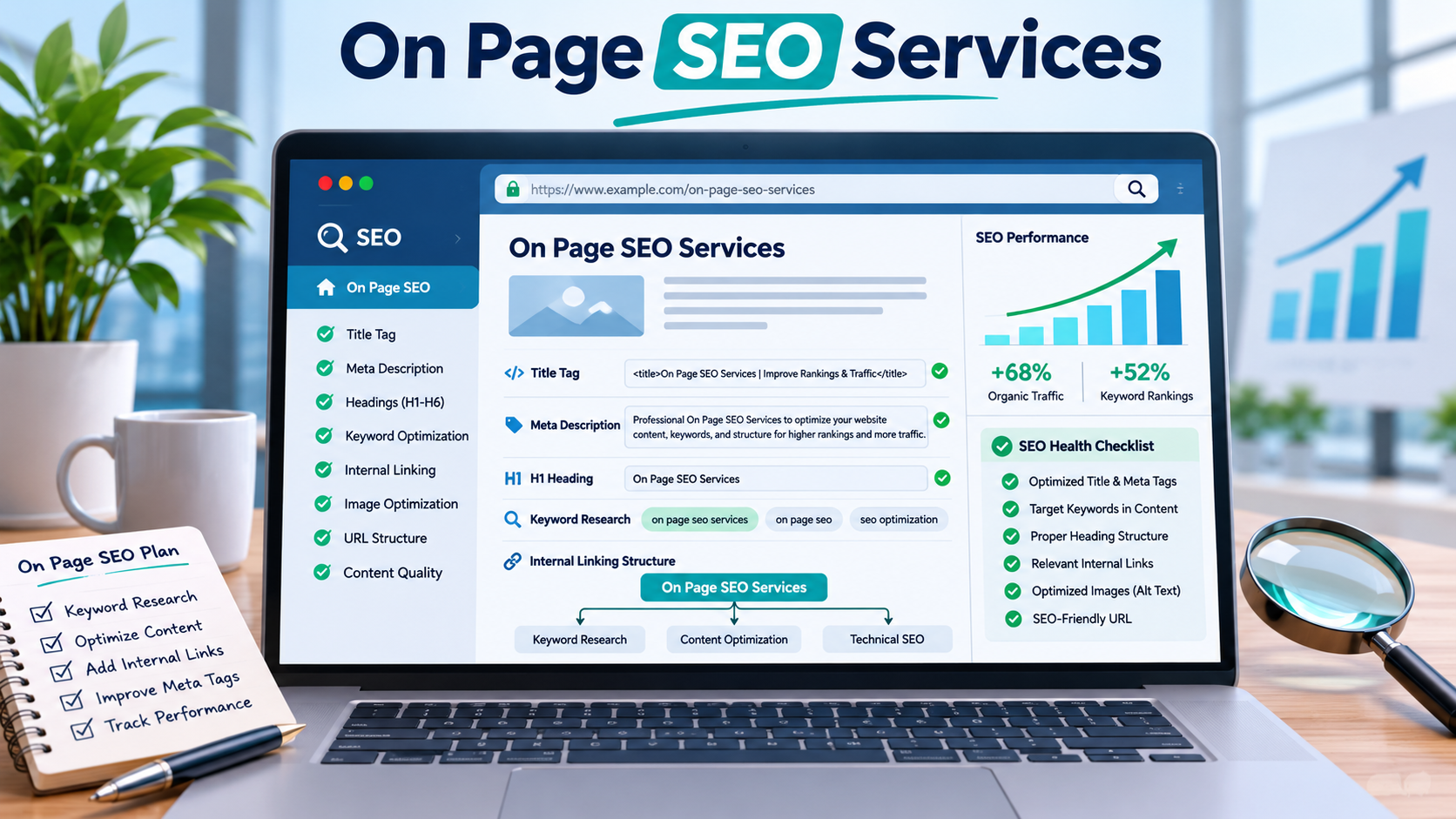
On page SEO Services and adapts a site to ensure that both search engines and customers can access and benefit from information. Common services provided include researching keywords, optimising text, optimising title tags and meta descriptions, internal linking and image and on page SEO analysis. Businesses can utilise on page SEO to boost unpaid search engine presence and therefore drive targeted traffic to their websites in addition to facilitating lead and sales generation – without solely depending on paid advertising.
Services provided can differ between businesses. Recognising precisely what a service entails will allow you to ensure that you are not receiving and implementing unessential advice and/or work.
What Is On Page SEO?
Whilst off page SEO relates to actions outside a business’ site, including acquiring backlinks, on page SEO relates to aspects which can be altered by a business and is concerned with content and site structure.
Professionals analyse what a site page is currently offering and in relation to its target market. They can then advise and/or go on to modify content accordingly. As stated in Google’s SEO Starter Guide, it is essential that content is easy to comprehend and that a site is well structured.
For instance, if a Dallas based roofing business has a ‘services’ webpage but customers are searching for roofing supplies then this can be adapted. Customers can then be informed about the price of, and locations for, roof repairs together with details of how to book in for these.
Top 7 On Page SEO Services
1. Site Audit and Keyword Analysis
An initial audit enables professionals to ascertain which pages require optimisation. They assess current pages and analyse their search engine performance, alongside competitor pages and keywords.
Keywords are then analysed and mapped to appropriate URLs. Doing this allows the differing functions of a site to be recognised and can also highlight areas of a site where there may be excessive duplication of pages competing for the same keywords.
2. Title Tags and Meta Descriptions
Alongside conveying information regarding a page, good title tags can entice people to click on them. Meta descriptions provide a summary of a webpage and can also affect how enticing an entry is within a search engine results page.
As with titles, meta information must represent a page realistically. Although Google may choose to present differing title tags and/or meta descriptions for different searches, optimising them does not always result in a specified outcome.
3. Optimised Content
Common optimisation techniques centre around filling knowledge gaps, rectifying out-of-date information, and streamlining and clarifying text.
Businesses may also need to commission content to be written as pages may require significant re-working. Alternatively, there may be no page covering key areas of interest. Again, Google’s advice on developing content with a person in mind can be a good reference point for ascertaining if content is effectively meeting the needs of a target market.
4. Structuring and Clarifying Content
Headings enable customers to navigate a site and locate pertinent information without needing to read all the text. For example, a ‘services’ page might contain subheadings detailing price, service provision and booking procedures.
Professionals can further enhance content by breaking up lengthy text, and rewording and clarifying statements. Optimisation should focus on ease of understanding, not just keyword inclusion.
5. Internal Linking and URL Optimisation
Internal links guide people to supplementary pages relating to a subject. Continuing the previous example, an accountancy practice could hyperlink from a page detailing tax preparation to one detailing its business taxation service.
Clearly labelled URLs can also assist with recognising webpage themes. Although it is usually best not to alter current URLs (particularly if they are successfully driving traffic and/or have acquired backlinks), if modifications are essential then suitable redirects must be put in place and internal links updated accordingly.
6. Image and Site Optimisation
Images can cause sites to load slowly, particularly for those accessing the internet via a mobile. Optimising images thus involves reducing their file size through resizing, choosing optimal image types and compression.
Alt text can then convey the essence of an image for those unable to view it. Further technical SEO work may also be required to address wider concerns relating to hosting, design and/or coding.
7. Analysis and Reporting
As well as effecting optimisation, it is beneficial to document undertaken work and then analyse its effects. Reports are frequently prepared showing which URLs were altered, what was changed and subsequent performance trends.
Site owners can analyse a site’s search presence using Google’s Search Console. Combining this with analytical and conversion data will enable assessment of how effectively a site is converting traffic into customers.
How Much Do On Page SEO Services Cost?
The cost will depend on factors including the number of site pages, market competitiveness, content standard and both the level of analysis and work required. Generally, the work needed to optimise a local business website (normally comprising around 5 pages) differs from that for an online retail site (often containing many hundreds of product pages).
Various pricing methods are often used:
| Pricing method | Applicable for | Information to obtain |
| Page-based | Certain pages | Research, creation and optimisation |
| Project-based | Website reoptimisation | Number of URLs and number of allowable amendments |
| Monthly subscription | Continuous optimisation | Monthly work and reporting |
| Hourly consultancy | Target issues | Anticipated hours of work and role undertaken |
In the USA, in addition to contrasting prices, ask for detailed cost analyses. Although a low-cost audit may be provided, a more expensive service can often provide added value by also encompassing delivery and quality assurance. Investigate if additional charges apply for content development, IT personnel assistance and/or further reporting.
What Pages Should Be Optimised?
Work on pages which either have defined business relevance or which realistically can be utilised to target suitable customers. Service, core product and popular informative pages which do not fully address customer interests can all be good areas for optimisation.
Suppose a home improvement company has 20 website pages and a restricted budget. It may be more advantageous to optimise key service pages, in preference to reworking all previous blog posts. If these service pages are currently performing well, attention may then shift to enhancing informative pages.
Analyse current page performance. Where there has been a reduction in traffic, factual information may require amendment. Conversely, for pages with stable traffic volumes but low enquiry levels, service information and/or contact details may require optimisation.
How to Identify a Credible SEO Service
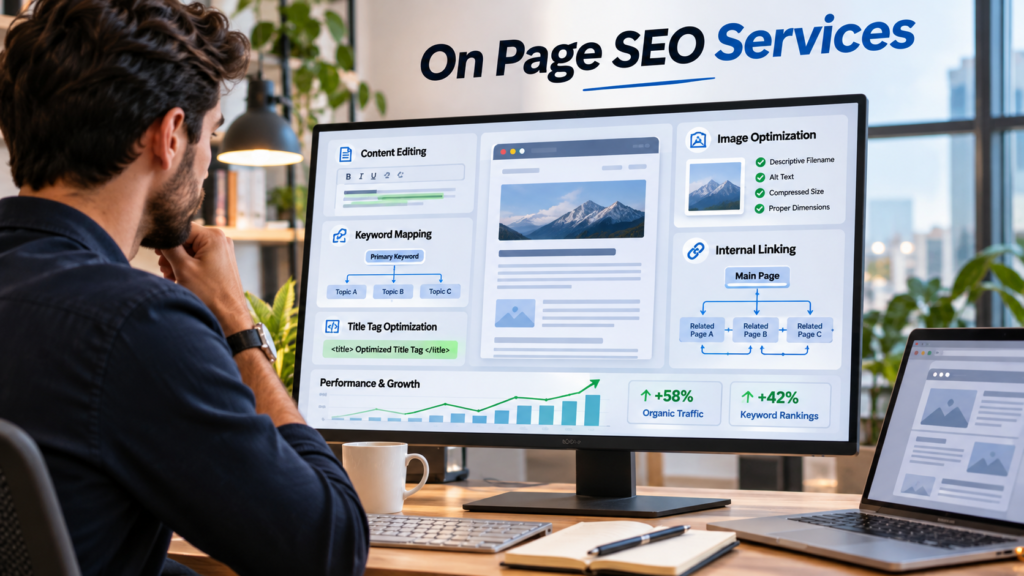
A credible SEO service will be able to describe its working methods and define precisely what it will do. It should also set out realistic expectations. Request sample audit information or confidential report in order to gauge the standard of offered advice.
As with any other SEO agency, when conducting your own research for ‘seo service glorvix’ apply the same evaluation process. Merely having an easily recalled brand name and/or advertising does not necessarily mean that a service is of high quality.
Before agreeing a deal, ascertain who will execute optimisation work, how alterations will be approved and who will own created content. Furthermore, discover how reporting will be provided. Avoid agencies which assure top search engine rankings or emphasise keyword inclusion as the principal determinant of success.
Conclusion
Having an in-depth knowledge of your customers’ needs is fundamental to successful on page SEO. Ideally, a good service will therefore carry out analysis, implement improvements, produce easily understood content and offer insightful reporting. Firstly, determine key business site pages and then ask for a service to detail how particular optimisations can contribute to achieving defined objectives.
FAQs
How long does on page SEO take to show effects?
Depending on how search engines rescan sites, some changes can demonstrate effects relatively quickly. However, substantial results often take weeks or even months to emerge. Factors affecting timescales include market conditions, how regularly a site is rescanned by search engines, site quality and the degree of alteration undertaken.
Is on-page SEO suitable for small businesses?
Yes. Small businesses can begin with a manageable selection of service pages rather than optimizing their entire website at once. Prioritizing pages related to customer inquiries and revenue helps direct a limited budget toward meaningful improvements.
Can on-page SEO work without backlinks?
Pages can appear in search results without an active link-building campaign. However, competitive queries may require additional efforts beyond page optimization. Content relevance, technical accessibility, competition, and other ranking considerations also influence visibility.
Do I need to rewrite all my existing content?
No. Keep accurate content that already serves readers well. Focus on outdated information, missing explanations, unclear headings, and pages that do not match their intended search queries. Unnecessary rewrites can introduce errors or remove useful details.
What should I receive after an SEO project?
Request a list of optimized URLs, documented changes, updated content or metadata, and outstanding recommendations. A useful handover also includes baseline performance measurements and guidance for monitoring results after the changes go live.
Leave a Reply