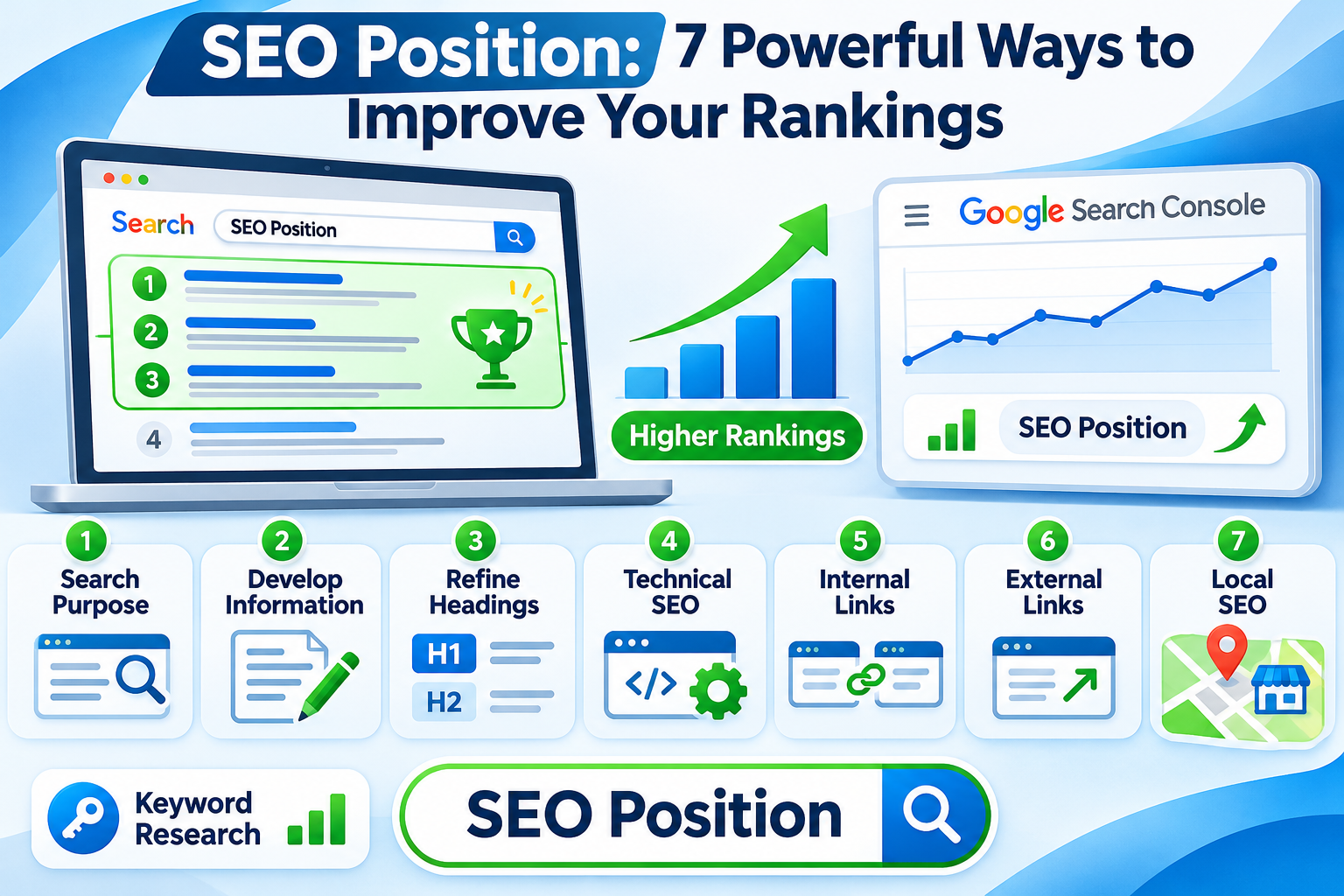
Your website can be indexed by search engines for certain keywords. Ideally a page will feature at number 1 in the search results. Generally the lower the number the better. Businesses can check their Search Engine Position using Google Search Console and/or specialist SEO Position. Suitable information can then be developed, technical issues can be addressed and authority can be enhanced to affect a business’ Search Engine Position. There are numerous factors which can impact upon a company’s Search Engine Position. These include; a keyword, location and the level of competition.
Although good search engine positions can widen a business’ audience, good quality is also extremely important.
What is Search Engine Position?
Information is analysed and ordered by search engines taking into account both its relevance and quality. This then indicates a websites or page’s position in search results for a given keyword.
A digital marketing agency can therefore be in the top 3 positions for the term ‘keyword research’. It is however possible for this agency to feature at position 18 for a highly competitive keyword. Despite both instances relating to the same company, there will therefore be differing levels of audience exposure.
Consequently a business can analyse its Search Engine Position in order to evaluate how successfully it is currently practising SEO. It can also highlight sections of its website that require further examination and development.
Alongside natural search results, users can also access sponsored search and map results.
Understanding Average Position within Google Search Console
This generally demonstrates a websites or page’s Search Engine Position. Google calculates an average based on the best position that a property or page has appeared at for a set of search results. An example of this is highlighted below:
| Search impression | Position |
| 1 | 3 |
| 2 | 5 |
| 3 | 7 |
| Average position | 5 |
Whilst this suggests that content is most commonly located at position 5, this is not always the case. Typically, an average Search Engine Position can worsen even if suitable content is being shown for new keywords. Frequently, examination of particular searches and pages is a more useful method of analysis than simply looking at a website’s overall average Search Engine Position.
How to Analyse Search Engine Keyword Positions
Google Search Console
This free resource allows a business to access analytical data for its authorised websites. Within the ‘Performance’ section there is a ‘Search results’ subsection which enables analysis of relationships between search terms, impressions and clicks along with search engine positions.
Login to Google Search Console and choose one of a business’s authorised websites. Next:
- Click on ‘Performance’;
- Choose ‘Search results’;
- Activate the ‘Average position’ option;
- Establish a period for analysis. Specific countries and/or devices can also be selected for analysis.
Then analyse data within the ‘Queries’ tab. Investigate the relevant pages for each query.
Analysis can often be carried out by comparing data for varying periods. Furthermore, analysing data for a specific country (such as the United States for instance) can be especially advantageous for businesses aiming to appeal to consumers in that country.
Specialist SEO Analysis Software
Various pieces of specialised software (for instance Semrush and Ahrefs) can analyse search engine positions for specific words in defined locations and on particular devices. Such software is frequently used to analyse rival businesses and to ensure that the same keywords are analysed consistently.
Although distinct from Google Search Console, these pieces of software can occasionally produce differing Search Engine Position results. Ideally the same type of software should therefore be utilised.
Seven Methods to Boost Search Engine Positions
1. Recognise Search Purpose
Analyse what people are trying to discover when they type in a keyword. If someone is seeking a definition for instance, they will likely want this to be provided. Alternatively, if they wish to compare services, they may want to know associated pricing, knowledge and reviews.
Analyse popular search topics and implement this information. However, refrain from directly replicating other sites.
2. Develop Information
Investigate which pages are currently being shown in search engine results and analyse how successfully they are driving highly relevant traffic. Identify where more information could be provided, where information may be inaccurate and where headings and/or queries are not being adequately addressed.
Google stresses that ideally content should be genuinely useful. Simply increasing the volume of content is often not an adequate solution to content related issues.
3. Refine Headings
Ensure that a page has a suitable heading. Sub headings should also be logically structured. Key information should be presented prominently.
Whilst a well composed meta description can reflect the quality of a page, modifying this is generally not an effective means of enhancing a page’s Search Engine Position. Furthermore, a page’s meta description should not suggest that it provides information which it in fact does not.
4. Address Technical SEO Issues
Confirm that significant pages can be viewed and indexed. Investigate inappropriate use of a ‘noindex’ tag, canonical tags and hyperlinks. Additionally, examine whether or not a site is mobile responsive.
The Google SEO Starter Guide also provides valuable advice regarding website development. This can in turn assist search engines in understanding a site’s information.
5. Add Internal Hyperlinks
Connect to other relevant pages. For example, a keyword research guide could appropriately contain a hyperlink to a page detailing search engine positions.
As well as enabling extra information to be accessed, internal hyperlinks indicate to search engines the relationships between different pages. Once again, quality should be the key consideration in devising a business’ internal hyperlink strategy.
6. Acquire Suitable External Hyperlinks
Develop high quality information so that others are motivated to hyperlink to it. Comprehensive, pioneering and good quality, backed information can all be compelling reasons for external websites to hyperlink to a business’s information.
Never accept dubious external hyperlinks as these can adversely affect a business’ Search Engine Position. As with internal hyperlinks, relevance and the value that external hyperlinks can offer to individuals should predominantly underpin a business’ external hyperlink strategy.
7. Enhance Local Search Engine Exposure
Companies providing local services need to ensure that correct business information is available and that relevant service pages exist. Depending on an individual’s location, search results for terms such as ‘SEO near me’ can vary.
Where relevant, update a business’ Google Business Profile. Rather than developing dedicated pages for each area (for areas that a business does not serve), explicitly state which areas a business does serve.
Which Search Engine Positions Should be Examined?
Below are indicative ranges which can generally provide an idea of what should be analysed. Bear in mind that these are not definitive.
| Search Engine Position range | Action to take |
| 1-3 | Check that information is up-to-date and analyse click-through rate |
| 4-10 | Develop and refine search presentation |
| 11-20 | Analyse and add internal hyperlinks |
| 21-50 | Investigate search purpose, competition and information |
| >50 | Evaluate relevance and indexability and then decide on further actions |
Whilst a business may attach more significance to a keyword for which it has a Search Engine Position of 12 rather than one for which it has a position of 2, it is also important to consider how potential customers may be seeking information and to predict their likely search behaviour.
Creating a Targeted SEO Position
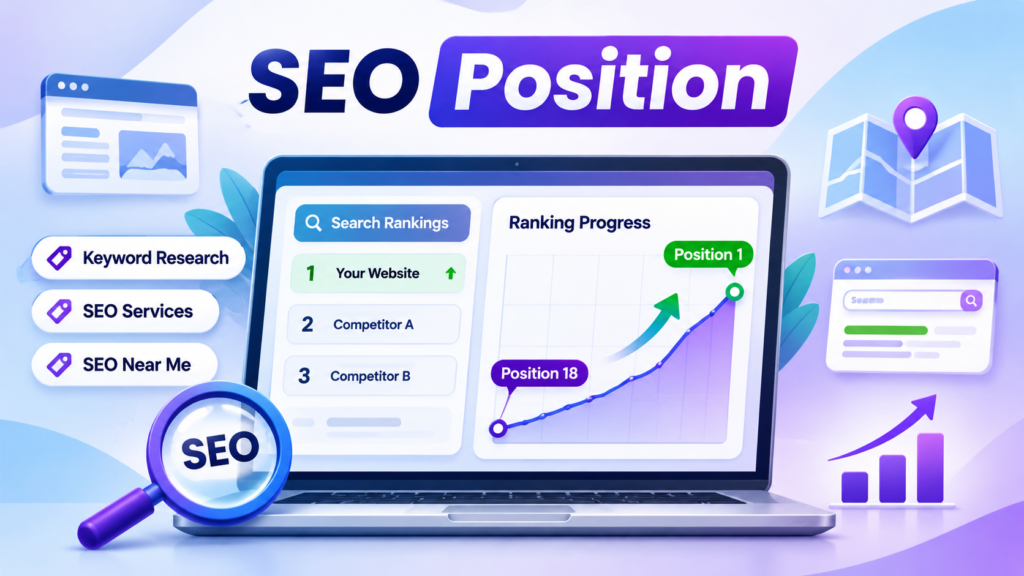
This is a focused and methodical strategy for attaining specific SEO aims. Rather than attempting to optimise all of a business’ webpages, concentrate on a limited number of URLs which have potential for optimisation.
Appropriately analyse information and then implement targeted changes. Note the date that content was developed. Following this analyse search impressions, positions, clicks and relevant conversions. Allow enough time for search engines to recognise new developments before commencing analysis.
In Summary
Initially businesses should analyse customer requirements and explore why current webpages may not be functioning efficiently. They can then analyse their search engine keyword positions, develop information and address technical issues. Not only should businesses’ traffic be analysed but also their general performance to evaluate how well they are performing. Whilst endeavouring to enhance a business’ Search Engine Position is important, it is also essential to understand the reasons behind this pursuit.
Frequently Asked Questions
Is position one always the best SEO ranking?
It is the highest numbered ranking, but its business value depends on the keyword and search layout. A top result for an irrelevant search may produce fewer qualified leads than a lower result for a valuable commercial query.
How often should I check my rankings?
Weekly reviews are a reasonable starting point for many websites. Monitor more frequently during major migrations or important launches, but avoid changing content simply because rankings fluctuate for a day or two.
How long does it take to improve rankings?
There is no fixed timeline. Results depend on competition, existing website quality, the changes made, and when search engines process them. Some improvements become visible relatively quickly, while others require sustained work over several months.
Why do my rankings drop suddenly?
Possible causes include technical errors, changing competition, shifts in search demand, or search system updates. Compare affected queries and pages before deciding whether the problem requires content changes, technical repairs, or further monitoring.
Does paying for Google Ads improve organic rankings?
No. Advertising can generate paid visibility, but buying ads does not directly improve organic search rankings. Treat paid advertising and organic optimization as separate marketing activities with their own performance measures.
Leave a Reply