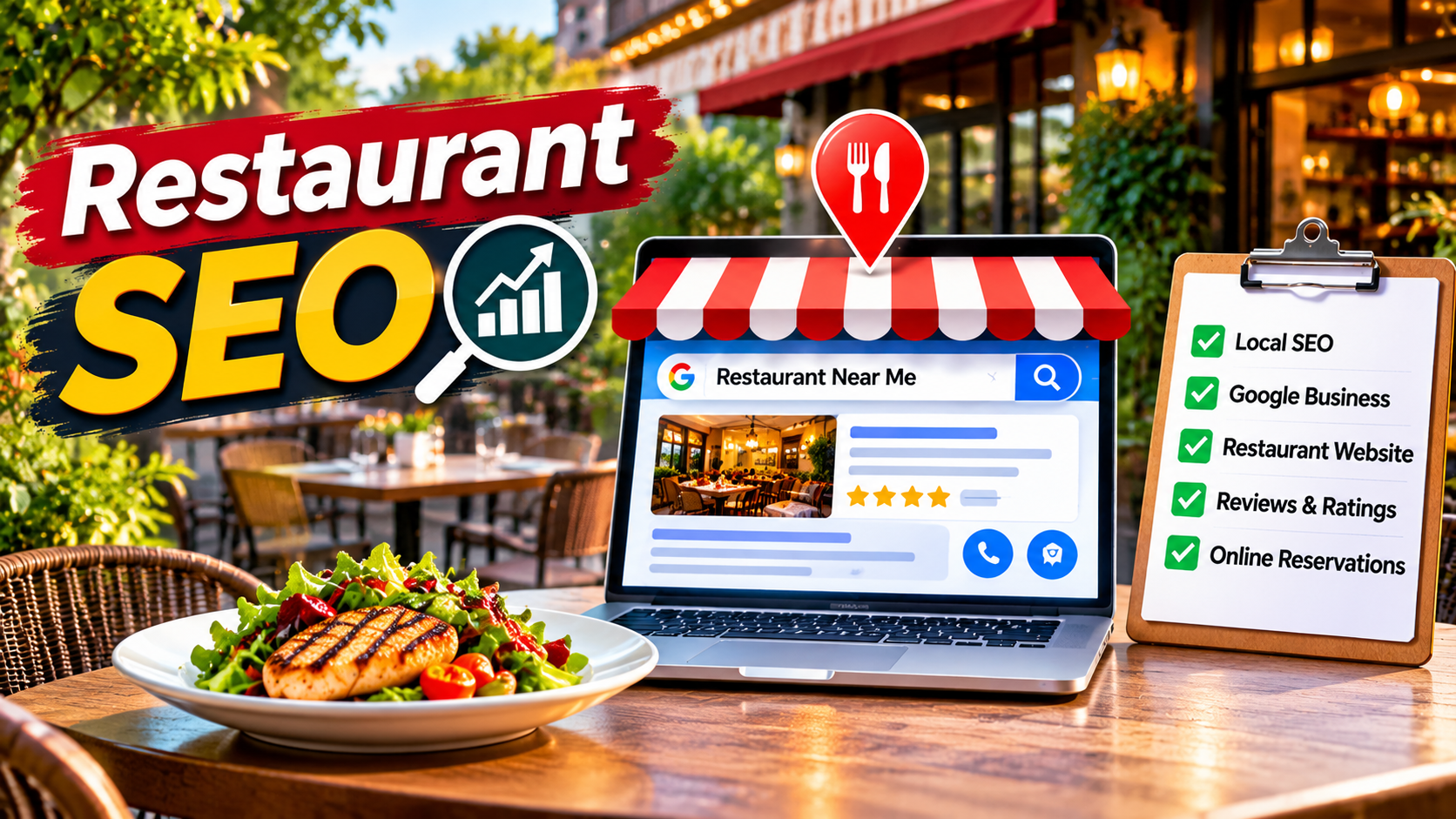
SEO for restaurants will help you rank in search results of Google Search and Google Maps when individuals search for restaurants near them. You may find that you can draw in locals to dine at your restaurant, increase your reservation numbers, and increase the amount of direct online ordering by optimizing your restaurant’s business profile, website, menus, and reviews from previous diners.
Whether you are operating a single coffee shop, a family-owned restaurant or a large multi-unit organization, the below methods will assist you in converting your online presence into paying customers.
What Is Restaurant SEO and How Does It Work?
It’s the method used by restaurants to increase their exposure in non-paid search results. The combination of optimizing local search and improving the restaurant’s website helps restaurants connect with consumers who are looking for a particular type of cuisine, dish, or experience.
Google states that there are three factors which impact how you rank locally.
- Relevance: How closely your business matches the search.
- Distance: How far your restaurant is from the customer.
- Prominence: How well-known your business is.
For instance, a highly optimized Chicago pizza restaurant could show up in the results if a person was looking for pizza places within a certain distance of where they were located.
10 Restaurant SEO Strategies to Attract More Customers
1. Audit Your Current SEO Performance
Begin with a search on the internet for your restaurant name along with some of the more common local keyword terms used when looking for restaurants in your area. Then check to see if both your website and your local listing show up as expected in the results.
Google Search Console can help you determine what issues exist in terms of indexing, search impressions, and clicks. Document where you are today as far as performance goes and compare your site, menu and business profile with competitors in your area.
This gives you a starting point for measuring improvements.
2. Optimize Your Google Business Profile
Claiming and verifying your Google Business Profile is critical to be found locally. After claiming/verifying your profile, you will need to fill out all of the required information as listed below:
- Business name, address and phone number.
- Accurate restaurant categories.
- Regular and holiday opening hours.
- Food and interior photographs.
- Menu, ordering and reservation links.
- Dining and accessibility options.
Make sure to keep your details current, especially during the holidays (like Thanksgiving and Christmas).
3. Target High-Intent Restaurant Keywords
Choose the right keywords for what your customers are looking for. Combine your location, type of food (cuisine), specific menu items (dishes), and types of service (services), instead of using general terms.
Assign relevant keywords to specific website pages.
| Keyword example | Target page |
| Italian restaurant in Chicago | Homepage |
| Gluten-free pizza Chicago | Menu |
| Italian catering Chicago | Catering |
| Private dining Chicago | Events |
| Restaurant name reservations | Booking |
Utilize Google Trends and Google Keyword Planner to investigate search volume. Incorporate keywords seamlessly into headlines, page titles, and meta descriptions.
4. Build a Fast and Mobile-Friendly Website
Customers will have no trouble finding your menu, hours of operation and contact information.
Use HTTPS, simplify the navigation process, use descriptive titles and meta descriptions, make buttons easy to click on and compress your large images.
Test your site with PageSpeed Insights. Complete a mobile test order so you can find problems that automatic testing will miss.
5. Optimize Your Menu, Ordering and Reservation Pages
Publish the menu as web-accessible text rather than just a image/PDF download. Also, provide details for each dish such as description, accurate pricing, and pertinent dietary information.
| HTML menu | Image-only menu |
| Search-friendly text | Harder to interpret |
| Easier mobile reading | May require zooming |
| Simple price updates | Requires image editing |
| Better accessibility potential | Limited accessibility |
Visible Ordering and Reservation Buttons. Eligible businesses can use Google’s Preferred Ordering and Reservation Links feature to add links for customers to make orders or reservations.
6. Collect and Manage Genuine Customer Reviews
Ask customers to provide you with honest feedback regarding their meal, and make it as easy as possible for them to do so by giving them a review link or a QR code.
Respond positively and negatively to reviews. Address common issues with the customer’s experience, and use their input to help you provide a better experience for future customers.
Never buy reviews, reward people to post reviews on Google and/or prevent unhappy customers from posting about their experience.
7. Build Local Citations and Quality Backlinks
A local citation is an online mention of your restaurant’s business information.
The accurate listing of businesses on multiple platforms such as Yelp, TripAdvisor, Apple Business Connect, and Bing Places for Business is maintained.
Prioritize establishing genuine local relationships with local food bloggers, community events, newspapers, and business organizations to build relevant back links; do not prioritize obtaining large numbers of low quality links.
8. Create Useful Location-Specific Content
Develop a web page specifically for each legitimate restaurant. Provide the hours that the business is open, directions to the restaurant, the menu of items offered at the restaurant, information regarding where customers may park, and what types of services are provided by the restaurant.
I’ll create a blog post that contains valuable information on private dining, catering, seasonal recipes and dietary preferences.
In addition, restaurants in Chicago and Milwaukee need to use separate page templates for each restaurant location instead of using the same content for both but changing only the name of the city.
9. Optimize Your Restaurant for AI Search
AI powered search tools can be used to locate restaurants. Be sure that you are consistently updating your business information, that your site is accessible and that you accurately describe your services.
Use Restaurant structured data that is relevant to provide information about the type of food you serve, where you are located and when you open for business.
Google suggests that you follow the same SEO rules when optimizing for AI search. There is no specific AI optimization technique (such as AI markup or structured data) that will provide guaranteed results.
10. Track SEO Performance and Customer Conversions
Measure customer actions instead of concentrating only on keyword rankings.
| Performance metric | Tracking tool |
| Organic search clicks | Google Search Console |
| Calls and directions | Google Business Profile |
| Website conversions | Google Analytics 4 |
| Completed reservations | Booking platform |
| Direct orders and revenue | Ordering system |
Monthly comparison of results. Please keep in mind that neither direction requests nor clicking the “Call” button indicate that there has been a successful visit or sale.
How to Turn Restaurant SEO Traffic Into Revenue
Your website can generate traffic from search engines, but it cannot guarantee that those who visit will purchase items. Therefore, if you are experiencing low conversion rates, your focus should be on improving the user experience for visitors to your site.
| Problem | Recommended solution |
| Low Maps visibility | Audit business information |
| Impressions but few clicks | Improve listing details |
| Traffic but few orders | Simplify checkout |
| Poor menu engagement | Improve menu accessibility |
| Third-party ordering dependence | Promote direct ordering |
For instance, if you had 1,000 organic website visits and your visit-to-order conversion rate was 4%, and you sold on average for $30, then those 1,000 organic visits may result in a total gross revenue of $1,200.
The above is a sample of how to compute, but not a guarantee of returns. You will need to track your completed transactions in order to determine what you have made.
How Much Does Restaurant SEO Cost?
The cost will depend on where you live, what the competition is like in your area, how well-maintained your website is, and what kind of marketing you need.
| Approach | Investment | Best for |
| DIY | Staff time and free tools | Small restaurants |
| Freelancer | Project or monthly fees | Independent businesses |
| Agency | Ongoing service fees | Competitive markets |
| In-house team | Salaries and software | Restaurant chains |
Begin with free tools. If you are having difficulty in optimizing due to technical issues, resource limitations, or multiple locations then look into professional help.
A 30-Day Restaurant SEO Action Plan
You don’t have to complete all of your tasks right now. Use the schedule below to create a solid basis for yourself.
| Week | Main tasks | Estimated time |
| Week 1 | Audit and update business profile | 2–3 hours |
| Week 2 | Optimize keywords, menus and website | 3–5 hours |
| Week 3 | Improve listings, reviews and backlinks | 2–4 hours |
| Week 4 | Configure tracking and review performance | 2–4 hours |
The above estimates are based on the initial steps involved in optimizing a small restaurant’s web presence. It is possible that your restaurant will need more extensive web development if you plan to make major updates to your site. Additionally, the time required to see improvement in search rankings could be much longer.
Common Restaurant SEO Mistakes to Avoid
Avoid these mistakes that can reduce visibility or damage customer trust:
- Stuffing keywords into website content.
- Publishing incorrect business hours.
- Purchasing fake reviews or backlinks.
- Creating duplicate location pages.
- Ignoring mobile website usability.
- Leaving broken ordering links unresolved.
- Measuring rankings without tracking sales.
Frequently Asked Questions
How long does restaurant SEO take to work?
Business information updates may become visible relatively quickly, while organic ranking improvements can take several months. Results depend on competition, website quality and existing visibility.
Can I do restaurant SEO for free?
Yes. Google Business Profile, Search Console, Google Analytics and PageSpeed Insights are free tools. Website maintenance and staff time may still involve costs.
How can my restaurant rank higher on Google Maps?
Maintain accurate business information, select relevant categories, earn genuine reviews and improve your website. Customer location also influences local rankings.
How long does restaurant SEO take to work?
SEO builds long-term organic visibility, while Google Ads can provide faster paid exposure. Both can complement each other depending on your budget and goals.
Do small restaurants really need SEO?
Yes. Local search optimization helps independent restaurants reach nearby customers looking for their cuisine, services or dining experiences without relying entirely on paid advertising.
Leave a Reply